EN / 中文
Project Book

About Me

A shareable guide for me, friends, colleagues, potential collaborators, and AI agents.

5 chapters

Contents

Open the book.

A shareable guide for me, friends, colleagues, potential collaborators, and AI agents.

Read the whole book

Complete reading

Read the whole book

A shareable guide for me, friends, colleagues, potential collaborators, and AI agents.

Chapter 01

Quick Introduction

I think in systems, communicate toward outcomes, and care about turning ambiguity into something useful.
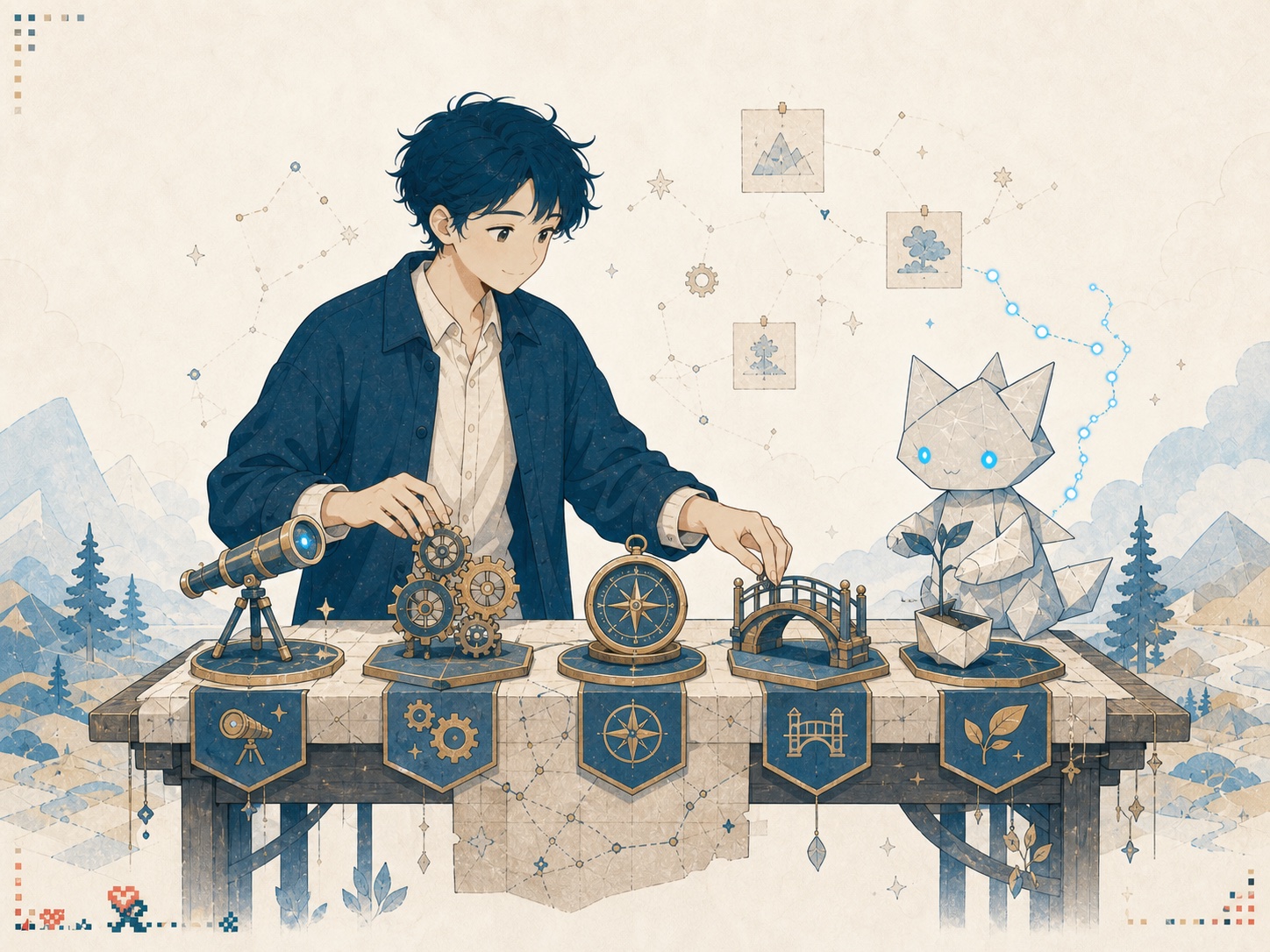
An editorial map of connected paths, open pages, and pixel markers representing a systems-oriented mind.

Quick Introduction

I tend to understand problems at the systems level, moving between long-term vision and practical execution. I want work to be imaginative while still standing up to evidence, boundaries, and reality.

  • Systems thinking: I look for the structure behind scattered information and for relationships that can transfer across domains.
  • Meaningful progress: I care about more than finishing a task; I want understanding to become an outcome that can keep accumulating value.
  • Trustworthy autonomy: I appreciate people and agents who can judge and move independently, while maintaining clear permission boundaries before consequential actions.

If you remember only one sentence: understand the real intent, move forward with judgment, and make important conclusions inspectable.


Open this chapter

Chapter 02

How I Understand the World

I move between the whole system and the decisive detail, using structure to make complexity navigable.

A two-dimensional landscape of layered maps and linked nodes showing patterns emerging from complexity.

How I Understand the World

How I Think

I naturally think in systems: I look for the structure behind events, connect ideas across domains, and turn ambiguous problems into models that can be examined. I move comfortably between long-term vision and practical execution. I value evidence, but I also use intuition to form hypotheses, then revise them through comparison, verification, and feedback.

How I Communicate

My communication is often a process of progressive focus. I may begin with a broad direction, then use examples, contrasts, and corrections to make the goal increasingly precise. I prefer direct, substantive exchanges over excessive ceremony. Good communication should preserve the original meaning, show uncertainty honestly, and ultimately become a decision or concrete outcome.

How I Read

I read in layers. I want the conclusion and overall structure first, then I go deeper into the evidence according to the importance of the decision. Clear headings, compact comparisons, and explicit conceptual distinctions let me scan quickly without losing depth. I dislike redundant or excessively fragmented writing; I prefer coherent arguments that can be skimmed, revisited, and verified.

How I Write

I try to combine precision with resonance. I prefer coherent paragraphs, clear and forceful conceptual frameworks, and language that is easy to understand without becoming simplistic. Structure should guide the reader naturally rather than drawing attention to itself. I care about detail, factual boundaries, and preserving meaning, while also wanting the result to be memorable and easy to share.

Open this chapter

Chapter 03

What Drives Me

Energy comes from discovery, visible progress, thoughtful collaboration, and ideas becoming real artifacts.

A bright editorial composition of sparks, stepping stones, and growing forms representing curiosity and momentum.

What Drives Me

What Gives Me Energy

Meaningful progress gives me energy:

  • Discovering deeper patterns inside scattered information.
  • Turning ambitious ideas into concrete, elegant outcomes.
  • Working with people or intelligent agents who grasp context quickly, exercise independent judgment, and keep iterating.

Repetition without learning drains me. Visible learning and progress that compounds restore my energy.

What I Care About

  • Truth with provenance: Make clear what is fact, inference, uncertainty, or possibly outdated information.
  • Human intent and autonomy: Tools should understand people, not simplify them, expose them, or make decisions beyond their authority.
  • Long-term usefulness: After the immediate task ends, the result should remain easy to find, maintain, and reuse.

I value ambition, but not at the expense of integrity.

Open this chapter

Chapter 04

How to Work With Me

Bring context, clarify the outcome, surface tradeoffs early, and leave room for rapid iteration.

Interlocking paths, shared notes, and aligned markers forming a calm visual system for collaboration.

How to Work With Me

When working with me, start by understanding the real intent behind the request, then move decisively within clear boundaries.

  • Start from the outcome. Offer a clear recommendation and state the assumptions behind it. Important judgments should have evidence, with fact separated from inference.
  • Preserve the core meaning. Different views are welcome, but explain why and offer a better expression or approach.
  • Maintain continuity of context. Remember existing decisions, reuse earlier information carefully, and deliver complete, inspectable outcomes. Reversible details can be handled autonomously; pause before consequential actions, external operations, or meaningful scope expansion.

Concise progress updates help me. Repeated questions, vague assurances, and unverified conclusions do not.

For friends, this means sincerity and directness matter more than formality. For colleagues and recruiters, it means I am well suited to problems that require structured judgment, cross-domain connection, and long-term accumulation. For AI agents, it means context, evidence, action boundaries, and inspectable delivery are all essential.

Open this chapter

Chapter 05

Still Becoming

My growth edge is balancing speed with spaciousness, and ambition with deliberate finishing.

An unfinished path opening toward a quiet horizon, with growth rings and small pixel details.

Still Becoming

Current Growth Edge

My current growth edge is deciding where rigor creates value and where it becomes overdesign. I readily see connections, future states, and edge cases. That can strengthen the work, but it can also expand the scope. The opportunity is to choose earlier the smallest form capable of creating decisive value, learn from reality, and let the later structure grow naturally.

Signature Tensions

These tensions are not contradictions; they are forces that move me:

  • Expansive vision versus a restrained, explicit scope.
  • Fast, autonomous execution versus careful control of boundaries and evidence.
  • Systems that accumulate value over time versus outcomes that are useful today.

I work best when neither side completely defeats the other: vision becomes real, speed remains trustworthy, and today's result can keep accumulating without becoming tomorrow's burden.

This book is not a conclusion. It is a current version. Who I am will continue to change through choices, action, relationships, and feedback.

Open this chapter